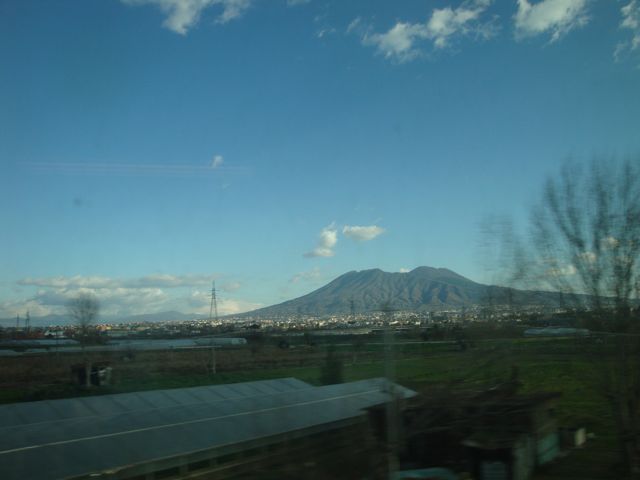
A few hours in a train is a wonderful
excuse for burying one’s head in a book and that is how I nearly missed my
first glimpse of home Vesuvius.
As I disembarked from the train I was accosted
by an illegal taxi driver. Irritated I marched to the underground station and
in half an hour I was in my brother’s flat in Vomero, on one of the hills of
Naples.

I had come to Naples to catch up with my
nonagenarians: my father who’s turned 92 a couple of weeks ago and my aunt, his
sister, who is going to be 96 in a couple of months. Therefore after dumping my
bags I hurried to my father’s flat in downtown Naples. He lives in a 1700
building in a flat that my parents bought from a Scottish family who had
settled in Naples centuries ago. I remember that on their letterbox they
spelled their surname in any possible way: Stewart, Stuardo, Stuarda, Stuarto.
My father despite his years is in very good shape and is still a good walker and
with the aid of a stick he does a few kilometres every day using public
transport only if necessary. When I was a child he would always take me on his
treks which meant exploring hidden corners and endless forgotten archaeological
and art treasures.
The day after I had to go to a public
office to sort out an ancient problem. I ended up bouncing between offices in
two different parts of the city and I failed. But looking from the bright side
I met a clerk from Turin with a spark in his eyes and a rather interesting and
philosophical attitude to life, who, at least offered to help. I had an
appointment with my father for lunch and I was now terribly late but we hadn’t
booked so he wasn’t worried. Naples is the birthplace of the pizza. My father
suggested we should have a pizza at the Trianon, one of the historical temples.
We obviously had to walk to the place, over an hour at his pace, as he stops
every time he sees something remarkable or amusing, which means every few
seconds as the streets of Naples are just one big theatre and museum at the
same time. He points at things by swinging his stick and missing people by half
an inch every time. We walked from the National Archaeological Museum near
where he lives, down to Piazza Dante cutting through the street called Cisterna
dell’Olio (The Oil tank); we got to Piazza del Gesù then followed Spaccanapoli,
‘Naples splitter’, a very long narrow street, which splits the old town. It is
the old Central Decumanus of the Greek-Roman city. One stretch of this long road is called San Biagio dei
Librai, an area where old bookshops still survive, a kind of ancient Charing
Cross Road.

Then after crossing Via Duomo we ventured
into Forcella a characteristic district home to two of the most famous
pizzerias, Trianon, my Father’s favourite and almost opposite, “da Michele”, where Julia Roberts was
filmed for “Eat, Pray and Love”. These two places make some of the best pizzas
in the world.
We sat upstairs. We were lucky to find a
table, it was two and the place was still packed. They were all locals except a
brave Japanese woman travelling on her own. The waitress appeared immediately
and because my father spelt out his order immediately – he always has a pizza
marinara - I didn’t have time to look at the list so I went traditional and
ordered a ripieno, also called calzone.
The Marinara is a very simple pizza: olive
oil, tomatoes, garlic, origano, fresh basil and a pinch of salt topping a thin
disc of naturally leaven dough. The Ripieno is a sort of large pizza dough
sandwich shaped like a giant raviolo stuffed with fresh ricotta, prosciutto or
salami, mozzarella and topped with a film of tomato sauce and fresh basil.
Within ten minutes we had two piping hot pizzas
in front of us. To wash it down we shared a bottle of Nastro Azzurro beer. The
pizzas were spectacular: hot, moist, beautiful. To make a perfect pizza is a
difficult job, a pizzaiuolo needs great skills, good quality natural dough,
high oven temperature (490C / 915 F), the right wood, a lot a lot of practise
but also love, passion and pride. They have them all at the Trianon. One of the
secrets of a Neapolitan pizza is the wood fired oven insulated by volcanic sand from Vesuvius.
We walked back this time along via Duomo.
The address no. 46 had on its wall a marble plaque with a quote by its most
famous resident, Libero Bovio, a poet and composer of Neapolitan songs whose
works became well known across the Atlantic. The quote is written in Neapolitan
and reads: ‘..and I am Neapolitan and If I don’t sing I’ll die’.

We stopped for a cup
of coffee in a bar, then we
returned along Via dei Tribunali, the ancient Main Decumanus. It was now the
time to see my aunt. I accompanied my father back home then set off to Mergellina
where she still lives in the flat where she and my father were born. It was
very mild so I walked. I found her well. She is always on the ball and very
jolly. Her memory is much better then mine. I asked her, as I always do, a lot
of things about our family history as she is the oldest surviving member and
loves to talk about the past. I spent a few hours with her. She even sung me a
couple of songs, just to prove that Libero Bovio was right. I asked her about
an extraordinary neighbour she had known very well. He was called Giovanni
Gaeta but was better known as E.A. Mario. He was a natural songwriter and had
produced some of the most sublime Neapolitan songs. But I am mentioning him
because of his most noteworthy achievement, a song called “La Leggenda del
Piave” (The legend of the river Piave), which became the leitmotif of the
Italian people in WW I. Later after the collapse of the Fascist regime it
briefly became the National Anthem.
Then I left and went to see two of my
dearest friends whom I’ve known for over 30 years, Maria and Gennaro. She’s a
university literature teacher and when we meet we can’t stop discussing books,
philosophy and mysticism. But she is a fantastic cook with the ability to
produce a gourmet meal within minutes. It is winter so we sat in the beautiful
veranda overlooking Piazza San Gaetano, a beautiful square which was the Roman
Forum two thousand years ago and the Greek Agora previously. That means that
the place has seen life (mostly good life) continuously for almost 3000 years.
Naples is one oldest continuously inhabited cities in the world.
Maria produced “vermicielle cu’ 'e
purpetielle”, spaghetti with small octopuses and tomatoes, a spectacular dish
that I have not had for years, artichokes in white wine and a sublime
improvised salad with lattuce, apples, fennel, capers, pine kernels and
oranges. Pudding was chiacchiere, carnival fried strips of dough, to dip in
sanguinaccio, a chocolate sauce. We washed down the meal with Prosecco to start
and then Aglianico, a full bodied red from the region. This was my first full
day, not bad from the food point of view.
The next morning I had a promise to keep. Many years ago I happen to read a rather interesting article in
the Financial Times about Naples. I remember that in the article they mentioned
Bar Mexico in Piazza Dante, a place where one can taste the best coffee in
Naples. As I have known the bar for ages, months ago I told the owner about my
discovery and promised that I would do my best to trace the article. Eventually
I succeeded, so this time I presented my findings to them. They were very
pleased because being praised in such a paper is a great honour. The coffee people wear a white uniform
and use a traditional old fashion espresso machine, with proper levers so steam
can measured out. My father and my sister have been having a coffee there every
Saturday morning for years. On Celia’s first trip to Naples I introduced her to
this place that she now defines as best purveyor of coffee in the world. They
only use coffee made by a small company, Passalacqua, which makes excellent
roasts. My favourites home blends are Mehari and Cremador (the latter is a
quite strong and chocolaty).
When in Naples I can’t resist drinking
coffee at bars with a dangerous frequency. Anyway I didn’t suffer sleeping
problems.
Maria and Gennaro invited me again for
supper and this time she produced an astonishing "pasta e patate con provola”,
pasta, potatoes and provola. I make my own version at home but in Tuscany I
found difficult to source provola, which is a smoked, fresh semi soft cheese,
not unlike mozzarella and typical of Naples.
Public transport in Naples is really rather
good but getting around is made even more fun by the publicity. Advertising in
Naples has it own rules, unlike the rest of Italy where advertisers know too
well that they have to woo the people. In Naples advertisements have to be
funny and witty, and they’re often in Neapolitan, my language, so in the
underground station sometimes I have to stop myself bursting into laughter, the
other passengers were less reactive as they probably listen to them every day.
When you live away from your home city it
is always nice to slot back in. Before going home to Lucca I had to do some
food shopping or I would never be forgiven by my girls in Lucca: taralli (savoury
crumbly ring biscuits with peppers and almonds), fresh buffalo mozzarella, pane
cafone (Neapolitan rustic bread that keeps for long time).